The Future of Substrates Is Not Just About New Materials – It’s About Reuse
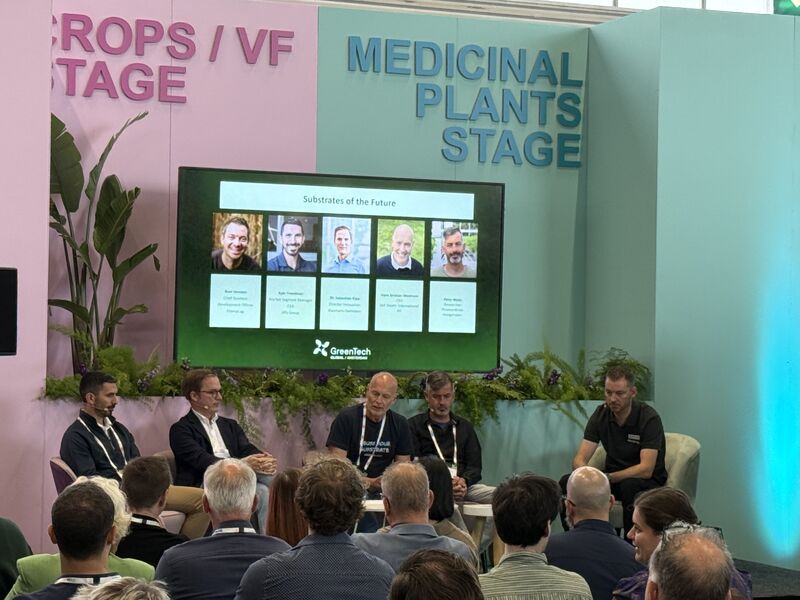
At this year’s GreenTech exhibition in Amsterdam, some of the world’s leading experts in growing media, research, and greenhouse production gathered for the panel discussion “The Future of Substrate.” Few topics could be more relevant to the future of horticulture.
For decades, peat has been the backbone of modern plant production. However, with increasing focus on climate impact, biodiversity, and sustainable resource management, the entire industry is facing a necessary transition. The question is no longer whether we need to reduce our reliance on peat—the question is how we do it.
Today, significant research efforts are being directed toward developing new and more sustainable growing media. Coconut coir, wood fiber, bark-based products, and a range of other alternatives are being developed and tested around the world. These initiatives are important and will undoubtedly contribute to a more sustainable future for horticulture.
However, during the discussion in Amsterdam, SoilSteam highlighted a perspective that often receives too little attention:
The most sustainable substrate is the substrate that has already been produced.
Why Replace a Substrate That Can Still Be Used?
Every year, millions of cubic meters of growing media are transported to greenhouse operations around the world. After a single growing season, much of this material is replaced with new substrate—even though it often retains excellent physical properties.
For several years, SoilSteam has focused on one key question:
Can substrate be treated and reused without compromising yield or crop quality?
The answer is becoming increasingly clear.
Documented Results from Leading Research Institutions
In collaboration with organizations such as Proefcentrum Hoogstraten in Belgium, SoilSteam has conducted extensive trials to document the effects of steam treatment and substrate reuse.
The results show that strawberries grown in steam-treated, reused substrate achieve yields comparable to those grown in new substrate.
This is no longer limited to small-scale research trials.
Several of Belgium’s largest strawberry growers are now conducting full-scale commercial trials, where entire greenhouses are grown on steam-treated and reused substrate and directly compared with greenhouses using new substrate.
The results so far are highly encouraging:
The yields are the same.
We are seeing similar results from ongoing full-scale trials in tomato and pepper production.
The Road Ahead: More Research and More Documentation
While the results are very promising, this is only the beginning.
SoilSteam will continue collaborating with some of the world’s leading researchers and research institutions to document the effects of substrate reuse across more crops, more substrate types, and a wider range of growing conditions.
Our objective is not simply to prove that reuse is possible.
Our objective is to demonstrate that substrate reuse is:
- Sustainable
- Safe
- Agronomically sound
- Economically profitable
One of the Greatest Economic Opportunities in Modern Horticulture
For growers, this is not only about sustainability.
It is also about economics.
By steam-treating and reusing their own substrate, growers can reduce substrate-related costs by up to 80% compared with purchasing new substrate year after year.
At the same time, growers gain:
- Full control of their own substrate
- Predictable costs
- Reduced exposure to rising substrate prices
- Lower transportation costs
- Less dependence on global supply chains
- Improved biosecurity and greater control over substrate hygiene
Growers no longer need to worry about delivery delays, increasing freight costs, or whether incoming substrate is as clean and reliable as expected.
A Powerful Climate Measure
The production and transportation of new substrate represent a significant share of the carbon footprint associated with modern horticulture.
By reusing substrate multiple times, growers can dramatically reduce the need for new raw materials while eliminating a substantial portion of the CO₂ emissions linked to substrate procurement.
For many producers, substrate reuse may be one of the most effective climate actions available—without compromising productivity or profitability.
The Future of Substrates Is Circular
The discussion at GreenTech clearly demonstrated that the industry is entering a period of significant change.
New growing media will undoubtedly play an important role in the future.
However, if our industry is to reduce resource consumption, costs, and climate impact on a meaningful scale, we must also ask a fundamental question:
Why use a substrate once when it can be used multiple times?
At SoilSteam, we believe the future of horticulture is not only about finding new substrates.
It is about creating a circular system where valuable resources are reused again and again—delivering the same yields, lower costs, and a dramatically reduced environmental footprint.
That is what we mean when we say that the future of substrates is circular.
You can use our calculator to estimate how much money and CO₂ emissions you could save by steam-treating and reusing your substrate instead of purchasing new material every season: https://substratecalc.com/